
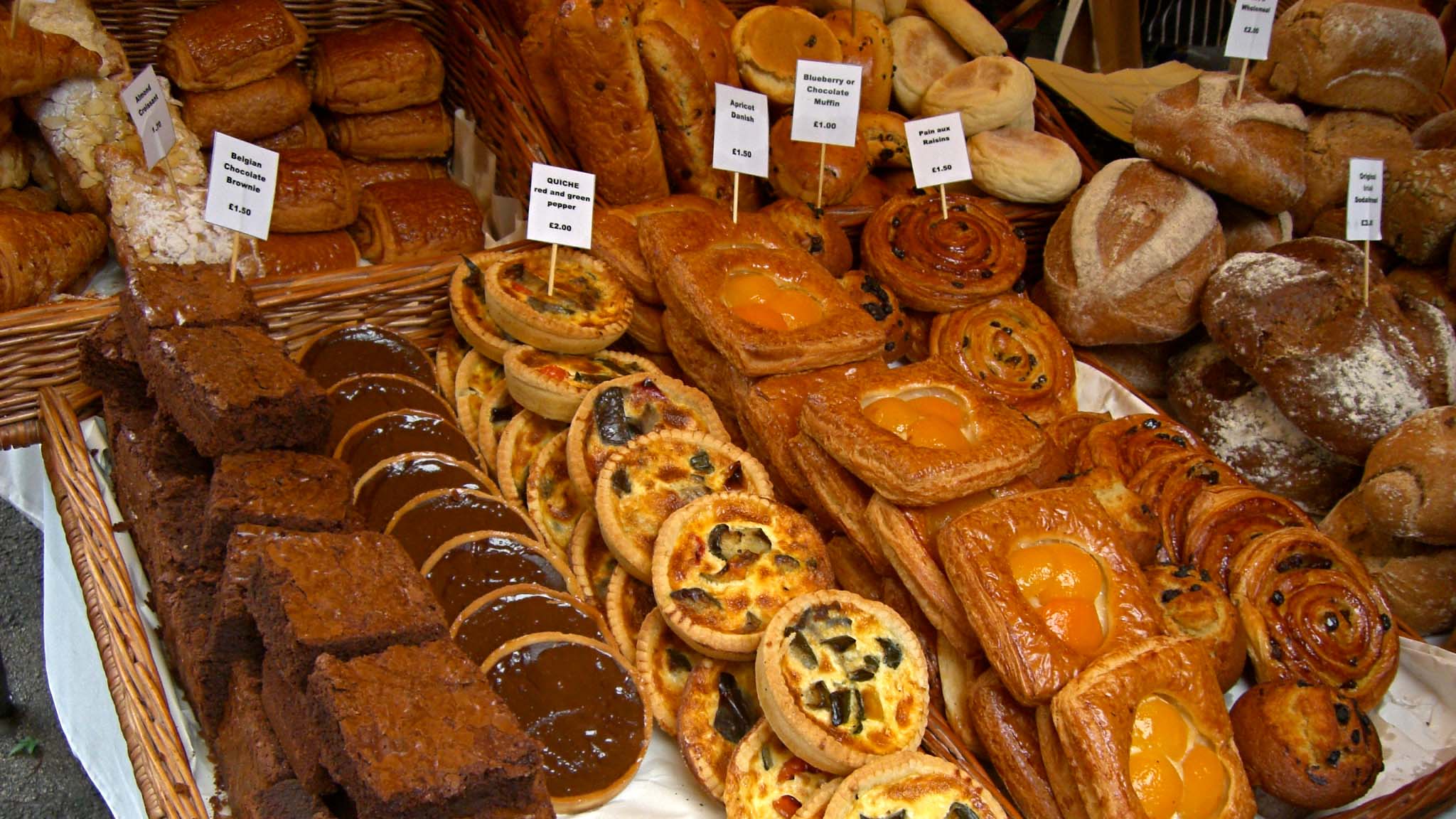
History
The European tradition of pastry-making is often traced back to the shortcrust era of flaky doughs that were in use throughout the Mediterranean in ancient times. In the ancient Mediterranean, the Romans, Greeks, and Phoenicians all had filo-style pastries in their culinary traditions. In the plays of Aristophanes, written in the 5th century BC, there is mention of sweetmeats, including small pastries filled with fruit. Roman cuisine used flour, oil, and water to make pastries that were used to cover meats and fowls during baking in order to keep in the juices, but the pastry was not meant to be eaten. A pastry that was meant to be eaten was a richer pastry that was made into small pastries containing eggs or little birds and that were often served at banquets. Greeks and Romans both struggled in making a good pastry because they used oil in the cooking process, and oil causes the pastry to lose its stiffness.
In the medieval cuisine of Northern Europe, pastry chefs were able to produce nice, stiff pastries because they cooked with shortening and butter. Some incomplete lists of ingredients have been found in medieval cookbooks, but no full, detailed versions. There were stiff, empty pastries called coffins or 'huff paste', that were eaten by servants only and included an egg yolk glaze to help make them more enjoyable to consume. Medieval pastries also included small tarts to add richness.
It was not until about the mid-16th century that actual pastry recipes began appearing.These recipes were adopted and adapted over time in various European countries, resulting in the myriad pastry traditions known to the region, from Portuguese "pastéis de nata" in the west to Russian "pirozhki" in the east. The use of chocolate in pastry-making in the west, so commonplace today, arose only after Spanish and Portuguese traders brought chocolate to Europe from the New World starting in the 16th century. Many culinary historians consider French pastry chef Antonin Carême (1784–1833) to have been the first great master of pastry making in modern times.
Pastry-making has a strong tradition in many parts of Asia. Chinese pastry is made from rice, or different types of flour, with fruit, sweet bean paste or sesame-based fillings. The mooncakes are part of Chinese Mid Autumn Festival traditions, while cha siu bao, steamed or baked pork buns, are a regular savory dim sum menu item. In the 19th century, the British brought western-style pastry to the Far East, though it would be the French-influenced Maxim in the 1950s that made western pastry popular in Chinese-speaking regions starting with Hong Kong. The term "western cake" (西餅) is used to refer to western pastry, otherwise Chinese pastry is assumed. Other Asian countries such as Korea prepare traditional pastry confections such as tteok, hangwa, and yaksik with flour, rice, fruits, and regional specific ingredients to make unique desserts. Japan also has specialized pastry-confections better known as mochi and manjū. Pastry-confections that originate in Asia are clearly distinct from those that originate in the west, which are generally much sweeter.
Types
Shortcrust pastry
Shortcrust pastry is the simplest and most common pastry. It is made with flour, fat, butter, salt, and water to bind the dough.pâte brisée is the French version of classic pie or tart shortcrust pastry.The process of making pastry includes mixing of the fat and flour, adding water, chilling and then rolling out the dough. Chilling before rolling is essential since it enables the fat (lard, butter etc) to harden again and thus create flaky layers in the dough. It also allows for even hydration and inhibits gluten formation. This results in a tender flaky pastry. The fat is mixed with the flour first, generally by rubbing with fingers or a pastry blender, which inhibits gluten formation by coating the gluten strands in fat and results in a short (as in crumbly; hence the term shortcrust), tender pastry.A related type is the sweetened sweetcrust pastry, also known as pâte sucrée, in which sugar and egg yolks have been added (rather than water) to bind the pastry.
Flaky pastry
Flaky pastry is a simple pastry that expands when cooked due to the number of layers. It bakes into a crisp, buttery pastry. The "puff" is obtained by the shard-like layers of fat, most often butter or shortening, creating layers which expand in the heat of the oven when baked.
Puff pastry
Puff pastry has many layers that cause it to expand or "puff" when baked. Puff pastry is made using a laminated dough consisting of flour, butter, salt, and water. The pastry rises up due to the water and fats expanding as they turn into steam upon heating. Puff pastry come out of the oven light, flaky, and tender.
Choux pastry
Choux pastry is a very light pastry that is often filled with cream. Unlike other types of pastry, choux is in fact closer to a dough before being cooked which gives it the ability to be piped into various shapes such as the éclair and profiterole. Its name originates from the French choux, meaning cabbage, owing to its rough cabbage-like shape after cooking. Choux begins as a mixture of milk or water and butter which are heated together until the butter melts, to which flour is added to form a dough. Eggs are then beaten into the dough to further enrich it. This high percentage of water causes the pastry to expand into a light, hollow pastry. Initially, the water in the dough turns to steam in the oven and causes the pastry to rise; then the starch in the flour gelatinizes, thereby solidifying the pastry. Once the choux dough has expanded, it is taken out of the oven; a hole is made in it to let the steam out. The pastry is then placed back in the oven to dry out and become crisp. The pastry is filled with various flavors of cream and is often topped with chocolate. Choux pastries can also be filled with ingredients such as cheese, tuna, or chicken to be used as appetizers.
Phyllo (Filo)
Phyllo is a paper-thin pastry dough that is used in many layers. The phyllo is generally wrapped around a filling and brushed with butter before baking. These pastries are very delicate and flaky.
Hot water crust pastry
Hot water crust pastry is used for savoury pies, such as pork pies, game pies and, more rarely, steak and kidney pies. Hot water crust is traditionally used for making hand-raised pies. The usual ingredients are hot water, lard and flour, the pastry is made by heating water, melting the fat in this, bringing to the boil, and finally mixing with the flour. This can be done by beating the flour into the mixture in the pan, or by kneading on a pastry board. Either way, the result is a hot and rather sticky paste that can be used for hand-raising: shaping by hand, sometimes using a dish or bowl as an inner mould. As the crust cools, its shape is largely retained, and it is filled and covered with a crust, ready for baking. Hand-raised hot water crust pastry does not produce a neat and uniform finish, as there will be sagging during the cooking of the filled pie, which is generally accepted as the mark of a hand-made pie.